
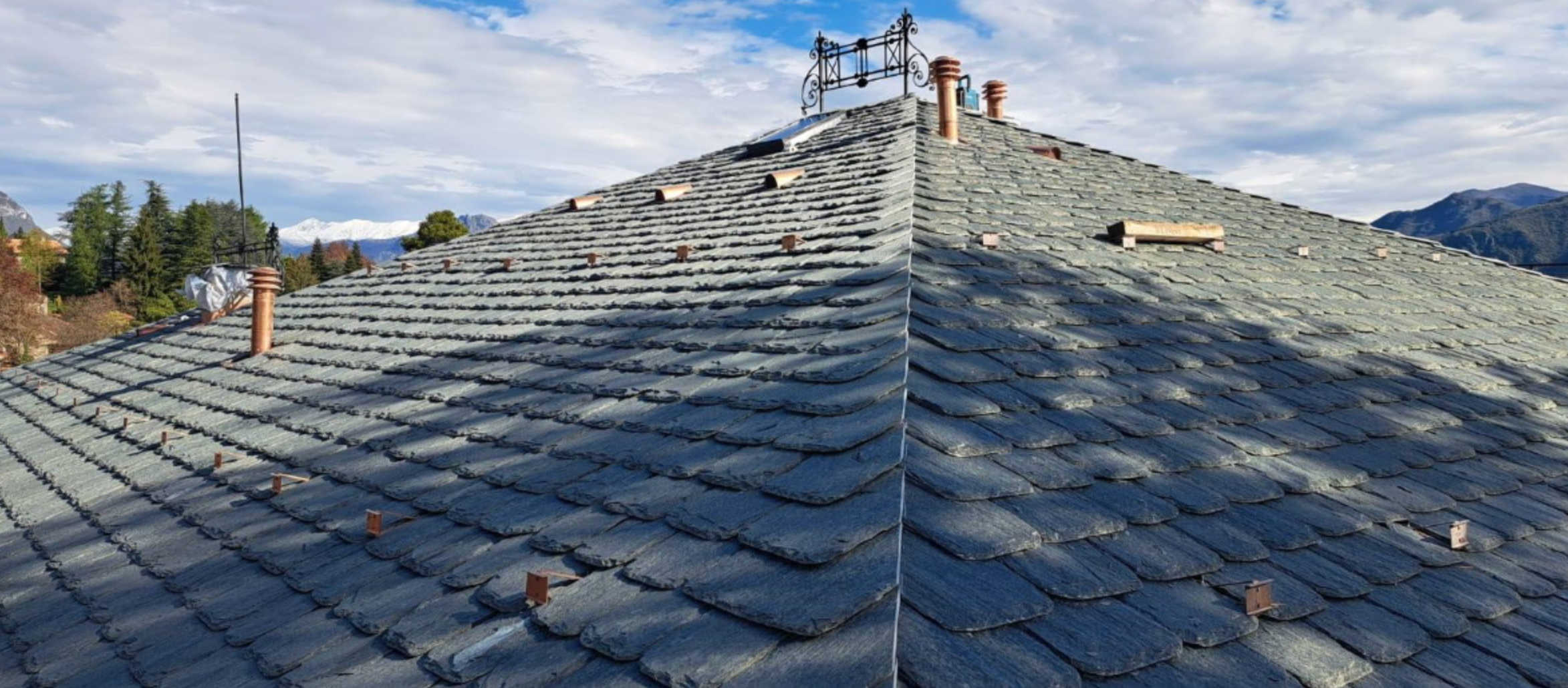
Serpentine schist
Serpentine schist is a metamorphic rock with unique properties. It is classified both as a natural stone and marble. It has unrivalled physical and mechanical properties, such as outstanding hardness, low water absorption and high resistance combined with exceptional beauty, which ensures it stands out from the crowd. Serpentine schist roofing tiles have been used in around the Italian alps on aristocratic residences and churches since the Middle Ages. Hand finishing during installation ensures every roof is unique and of superior quality, thereby adding value and prestige to the building. We extract and work serpentine schist directly from our quarries in the heart of the Italian Alps. Artisanal production and installation guarantee a 100% Italian-made, quality product with a lifetime warranty, and which is also 100% recyclable.
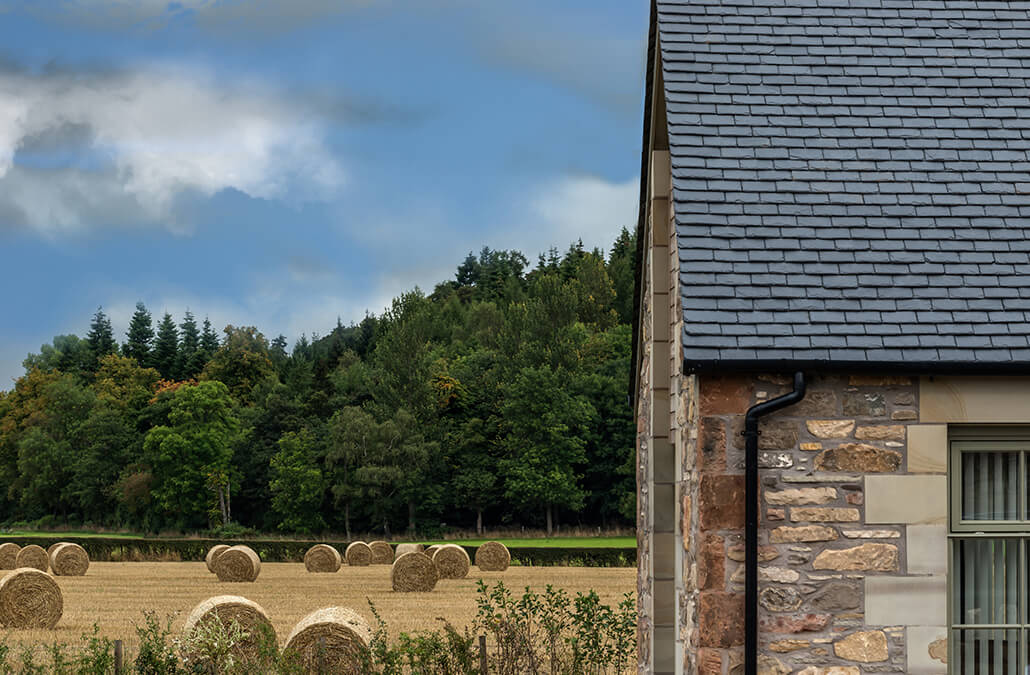
Slate
Slate is a fine-grained foliated metamorphic rock derived from a shale-type sedimentary rock composed of clay or volcanic ash through low-grade regional metamorphism. Slate is usually grey/green or black, and 90% of Europe’s natural slate used for roofing comes from Spain. The remaining 10% is divided between the United Kingdom, France, Belgium, Italy, and Germany. Slate tiles are entirely handmade, which guarantees the quality of every piece. We directly import slate tiles from our partner CUPA who own several quarries located in Spain, producing quality black and grey slate with a 50-year warranty.
The construction choices we make today shape the environmental, economic, and social well‑being of tomorrow.
Comparison of Serpentine Schist and Slate
|
Property |
Serpentine Schist |
Slate |
|
Water Absorption |
0.08% |
Typically higher, around 1-3% |
|
Compressive Strength (Perpendicular) |
301 MPa |
Varies widely; typically around 70 MPa to 120 MPa, with high-quality slate reaching up to 150 MPa |
|
Compressive Strength (Parallel) |
136 MPa |
Generally ranges from 70 MPa to 120 MPa |
|
Flexural Strength |
96.7 MPa |
Generally lower, around 8-12 MPa |
|
Flexural Freeze-Thaw Strength |
93.4 MPa |
Average of 10-30 MPa, but varies significantly; typically shows lower performance due to freeze-thaw deterioration |
|
Weather Resistance (Weathering) |
< 0.01 mm |
Typically ranges from < 0.1 mm to 0.5 mm but can vary depending on specific composition |
Key Points
- Material Composition:
- Serpentine Schist: Composed mainly of antigorite and olivine, with a robust metamorphic structure that contributes to its low porosity and high strength.
- Slate: Primarily consists of quartz, muscovite, and illite; its fine-grained texture allows it to be easily split into thin sheets.
- Weight and Density:
- Serpentine Schist: Has a unit weight of 2795 kg/m³, making it relatively heavy.
- Slate: Generally lighter, with typical weights ranging from 2500-2900 kg/m³, allowing for easier handling and installation.
- Water Absorption:
- Serpentine Schist: Extremely low water absorption at 0.08%, enhancing its suitability for outdoor applications such as roofing.
- Slate: Higher water absorption rates of 1-3%, which can affect its longevity in wet climates.
- Compressive Strength:
- Serpentine Schist: Offers strong compressive strengths with 301 MPa perpendicular to the bedding and 136 MPa parallel, demonstrating excellent load-bearing capacity.
- Slate: Typically shows compressive strength ranging from 70 MPa to 120 MPa for most slates, with high-quality varieties reaching up to 150 MPa.
- Flexural Strength:
- Serpentine Schist: Exhibits high flexural strength of 96.7 MPa, making it resistant to bending stresses.
- Slate: Generally has lower flexural strength, averaging 8-12 MPa, which may limit its structural applications.
- Flexural Freeze-Thaw Strength:
- Serpentine Schist: Superior freeze-thaw performance with a flexural freeze-thaw strength of 93.4 MPa, indicating resilience against temperature fluctuations.
- Slate: Average flexural freeze-thaw strength ranges from 10-30 MPa, with potential for deterioration under freeze-thaw cycles.
- Weather Resistance:
- Serpentine Schist: Exhibits exceptional weathering resistance, with a rate of less than 0.01 mm, highlighting its durability in harsh environmental conditions.
- Slate: Generally, weathering rates vary from less than 0.1 mm to 0.5 mm, influenced by composition and exposure.
Conclusion
Overall, serpentine schist is characterized by its impressive mechanical properties, low water absorption, and resistance to weathering and freeze-thaw cycles, making it ideal for construction in adverse climates. Slate, while still valuable for its aesthetic qualities and lower weight, may have limitations in terms of water resistance and freeze-thaw durability. Consideration of these properties will inform material choice based on specific project requirements and environmental conditions.